
This will ruffle some feathers.
But I’m ready for the heat, because numbers do not lie.
Many parents proudly hold education policies, believing they have fully secured their children’s future.
Yet some are trapped in plans that deliver poor growth and inadequate protection.
I have spoken to many disappointed parents.
By the time they discover the truth, walking away could mean losing a significant amount of money.
Let’s rewind.
Why Did You Buy That Education Policy?
Be honest.
You probably did not go looking for it.
Someone sold it to you.
An insurance agent asked:
“What Would Happen To Your Children’s Education If You Were No Longer Here?”
You paused, and fear took over.
You were shown a glossy brochure, guaranteed benefits and a lump-sum payout after 10, 15 or 20 years.
Then you signed.
But did you ask the two most important questions?
- Is this the best way to protect my children?
- Is this the best way to grow their education fund?
In some plans, you may contribute approximately Ksh 2.7 million over 15 years only to receive around Ksh 3 million.
After accounting for inflation, the real growth could be painfully small.
Here Is What They May Not Explain Clearly
An education policy is usually not a pure investment.
It combines savings and insurance.
Your premium is divided between building your education fund, paying for protection and covering other policy costs.
That is why the returns may be modest.
You could end up with neither enough protection nor meaningful investment growth.
Just an underwhelming cheque after years of commitment.
Education policies can still help people who struggle to save consistently or prefer guarantees over higher growth potential.
But convenience has a price.
If you are disciplined, consider a different strategy:
- Separate Protection From Investment
Use a suitable life insurance policy to protect your family if you die, suffer a critical illness or become permanently disabled.
- Invest for Growth
Build the education fund separately through a carefully selected Money Market Fund, Fixed Income Fund, Special Fund or Trust Fund: depending on your timeline and risk profile.
This gives you two clearly defined tools:
Protection for Life’s Uncertainties
Investment for Long-Term Growth
For example, if you can commit Ksh 50,000 monthly:
- Ksh 20,000 → Life protection
- Ksh 30,000 → Education investment fund
(Check The Example Below)
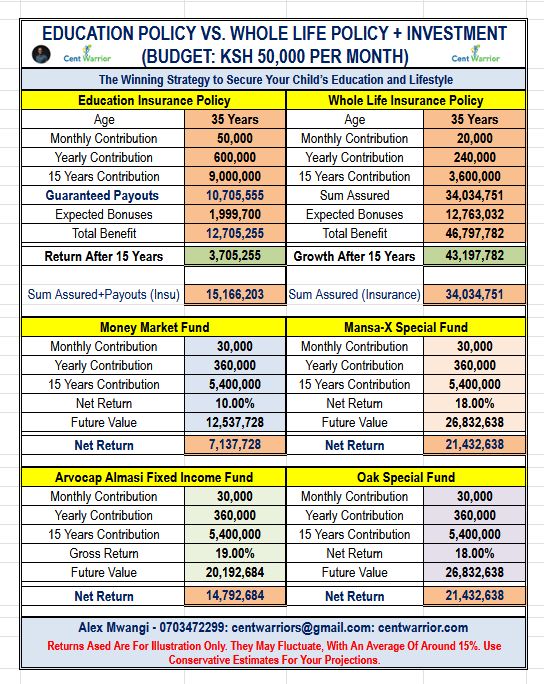
If you remain healthy and present, the investment builds the education fund.
If life happens before the goal is achieved, the insurance benefit protects the dream.
Strategy Over Emotion
That is strategy over emotion.
Do not buy an education policy simply because the presentation feels comforting.
Ask questions. Study the numbers. Compare the alternatives.
Alex Mwangi | WhatsApp: 0703472299